More Than 560 Million People in Africa Lack Access to Electricity
Although Africa possesses abundant oil and natural gas reserves, as well as critical minerals essential to the global energy transition, hundreds of millions of people across the continent still lack access to electricity.
Although Africa possesses abundant oil and natural gas reserves, as well as critical minerals essential to the global energy transition, hundreds of millions of people across the continent still lack access to electricity.
Africa’s energy potential and access to electricity are among the key issues being discussed at African Energy Week, which is taking place in Cape Town, South Africa, until October 16. Energy ministers, investors and oil company executives are gathering to discuss investment in the oil and gas sector, energy project financing, and ways to tackle energy poverty.
According to the available data, more than 560 million people in sub-Saharan Africa lack access to electricity. This accounts for approximately 86% of the global population without access to electricity.
Africa’s Oil and Natural Gas Reserves
Africa’s proven crude oil reserves are estimated at approximately 125 billion barrels, equivalent to 7.2% of global reserves.
The continent’s largest oil reserves are concentrated in Libya and Nigeria. Libya has 48.4 billion barrels of proven oil reserves, while Nigeria holds 36.9 billion barrels. Algeria ranks next with 12.2 billion barrels. Angola’s reserves stand at 7.78 billion barrels, South Sudan’s at 3.75 billion barrels, and Egypt’s at 3.3 billion barrels.
In 2024, Nigeria was Africa’s largest oil producer, accounting for approximately 23% of the continent’s output. Algeria and Angola followed, each contributing around 17%. Together, the three countries accounted for 56% of Africa’s oil production.
Interestingly, Libya, despite having the continent’s largest proven oil reserves, ranks fourth in terms of production. Political disputes and blockades have repeatedly disrupted oil production in the country. Foreign energy companies operating in Libya include Italy’s Eni, France’s TotalEnergies and Spain’s Repsol.
As for natural gas, Africa had approximately 18 trillion cubic metres of proven reserves at the end of 2023. Nigeria and Algeria account for around 58% of these reserves. Mozambique holds 2.84 trillion cubic metres, Egypt 2.21 trillion cubic metres, and Libya 1.51 trillion cubic metres.
Algeria and Nigeria are among the continent’s leading natural gas exporters. Meanwhile, a significant portion of Mozambique’s large offshore gas reserves, discovered in the 2010s, remains undeveloped.
The Role of Critical Minerals in the Global Energy Transition
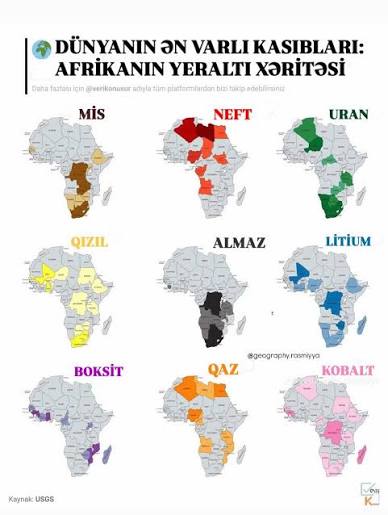
Africa is a major producer of several essential minerals used in electric vehicle batteries, energy storage systems and renewable energy technologies.
In 2025, African countries accounted for 71.2% of global cobalt production and 72.4% of global manganese production.
The Democratic Republic of the Congo (DRC) produces approximately 70% of the world’s cobalt. The mineral is primarily used in rechargeable batteries. However, hazardous working conditions in some mines and the risks faced by artisanal miners have attracted international attention.
South Africa accounts for approximately 38% of global manganese production, while Gabon contributes around 25%. Together with Ghana, these three countries account for 72.4% of global manganese output. Manganese is primarily used in steelmaking and also in certain types of batteries.
Zimbabwe is another major African lithium producer. In 2025, the country accounted for 9.6% of global lithium production. Lithium is a key component of batteries used in electric vehicles and renewable energy storage systems.
In addition, Madagascar, Mozambique and Tanzania collectively produced 222,000 tonnes of natural graphite in 2025, representing 11.9% of global production. Graphite is used in the anodes of lithium-ion batteries, in steelmaking and in other industrial applications.
Renewable Electricity Production Varies Across Countries
The share of renewable sources in electricity generation varies considerably across African countries.
In 2024, all electricity generated in Ethiopia and the Democratic Republic of the Congo came from renewable sources. In Uganda, Namibia and Eswatini, more than 96% of electricity was generated from renewables, primarily hydropower.
By contrast, renewable energy accounted for less than 5% of electricity generation in Algeria, Libya, Niger and Tunisia, where power production relies mainly on oil or natural gas.
Most of Ethiopia’s electricity is generated by hydropower plants. The country’s largest project in this sector is the Grand Ethiopian Renaissance Dam on the Blue Nile River. The dam began generating electricity in 2022 and was officially inaugurated in September 2025.
Access to Electricity Across Africa
In 2024, six African countries — Algeria, Egypt, Mauritius, Morocco, Seychelles and Tunisia —were reported to have achieved universal access to electricity. Together, these countries are home to approximately 215 million people, or around 14% of Africa’s population.
The situation is more challenging elsewhere on the continent. In South Sudan, only 5.4% of the population had access to electricity. The figure stood at 15.6% in Malawi and 22.5% in the Democratic Republic of the Congo.
In Nigeria, Africa’s most populous country, the electricity access rate was 62.5%. As a result, approximately 85 million people in the country remained without electricity, the highest national figure in the world.
Limited access to electricity, particularly in rural areas, has a significant impact on daily life. Many households still rely on kerosene lamps, candles and other traditional lighting methods after dark.
Overall, despite its vast oil and natural gas reserves and its strategically important mineral resources for the global energy transition, Africa has yet to resolve the problem of limited access to electricity. The main priorities include increasing investment in energy infrastructure, making more efficient use of existing resources and expanding access to affordable and reliable electricity for the population.