New risks for the global economy: What do experts expect for the end of 2026?
The global economy appears more resilient than expected as 2026 draws to a close. However, rising energy prices, inflationary pressures, high interest rates and geopolitical tensions remain key risks to global growth prospects.
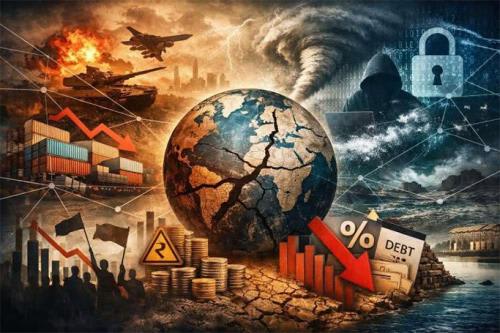
The global economy appears more resilient than expected as 2026 draws to a close. However, rising energy prices, inflationary pressures, high interest rates and geopolitical tensions remain key risks to global growth prospects.
According to the latest forecast released by the Organisation for Economic Co-operation and Development (OECD) on September 23, the global economy is expected to grow by 2.9% in 2026 and 3% in 2027. The OECD has raised its forecast for global growth in 2026 by 0.1 percentage point compared with its June projection.
The OECD forecasts that the US economy will grow by 2.2% in 2026, while the eurozone economy is expected to expand by 1% and China’s economy by 4.5%. At the same time, inflation across G20 economies is projected to rise to 4.1% in 2026 before easing to 3.6% in 2027.
Energy prices remain a key risk
The latest expert assessments place particular emphasis on developments in energy markets. S&P Global’s September forecast says Brent crude has once again risen above $100 per barrel, with higher energy prices putting pressure on the baseline economic outlook. Under the organization’s base-case scenario, Brent is projected to average $89 per barrel by the end of 2026 and $86 per barrel by the end of 2027.
The OECD also warns that a prolonged disruption to energy supplies in the Middle East could weigh on global growth. According to the organization, further increases in energy and food prices could weaken households’ real incomes, while higher yields on long-term government bonds could increase borrowing costs for governments.
A difficult choice for central banks
Higher energy prices have created a complicated situation for major central banks. S&P Global says the continued impact of energy prices on inflation could prompt the US Federal Reserve, the European Central Bank and the Bank of Japan to consider further monetary policy tightening. However, the extent of any additional rate increases will depend on inflation and labor-market data.
In a September 29 analysis, Investec also said that interest-rate increases had become unavoidable for some central banks, although such increases could later be reversed if energy costs decline next year.
In the United States, markets are focused on upcoming labor-market and inflation data. According to Reuters’ latest market analysis, the September employment report and inflation figures could have a significant impact on expectations surrounding the Federal Reserve’s next interest-rate decisions.
Changes in the dollar and gold markets
Expectations surrounding interest rates are also being reflected in currency and precious-metals markets. According to Reuters, the US dollar recorded its strongest monthly gain against the euro in 14 months in September. The move was supported by expectations that the US economy would remain strong and that interest rates could stay higher.
Gold, meanwhile, has moved in the opposite direction. Reuters reported that rising US Treasury yields and expectations of further Federal Reserve rate increases have put pressure on gold prices. Spot gold fell by as much as 4% on September 28, reaching around $4,111 per ounce.
What are analysts expecting?
A survey of chief economists conducted by the World Economic Forum in September also points to some stabilization in the global economic outlook. According to the survey, 56% of economists expect global economic conditions to remain stable or improve over the next year. At the same time, 97% of respondents identified geopolitical conflicts as one of the main sources of uncertainty.
Overall, the latest expert assessments indicate that the global economy has maintained growth in 2026 despite significant shocks. However, the trajectory of energy prices, inflation, central-bank interest-rate decisions and government borrowing costs will remain among the key factors determining the pace of economic growth in the period ahead.