Azerbaijan’s 2027 budget: which districts will receive subsidies?
Under the draft law “On the 2027 State Budget of the Republic of Azerbaijan”, none of the country’s 67 cities and districts is allocated a subsidy (dotation) from the state budget to cover its local expenditures next year. The only territorial unit that will receive a state budget subsidy is the Nakhchivan Autonomous Republic.
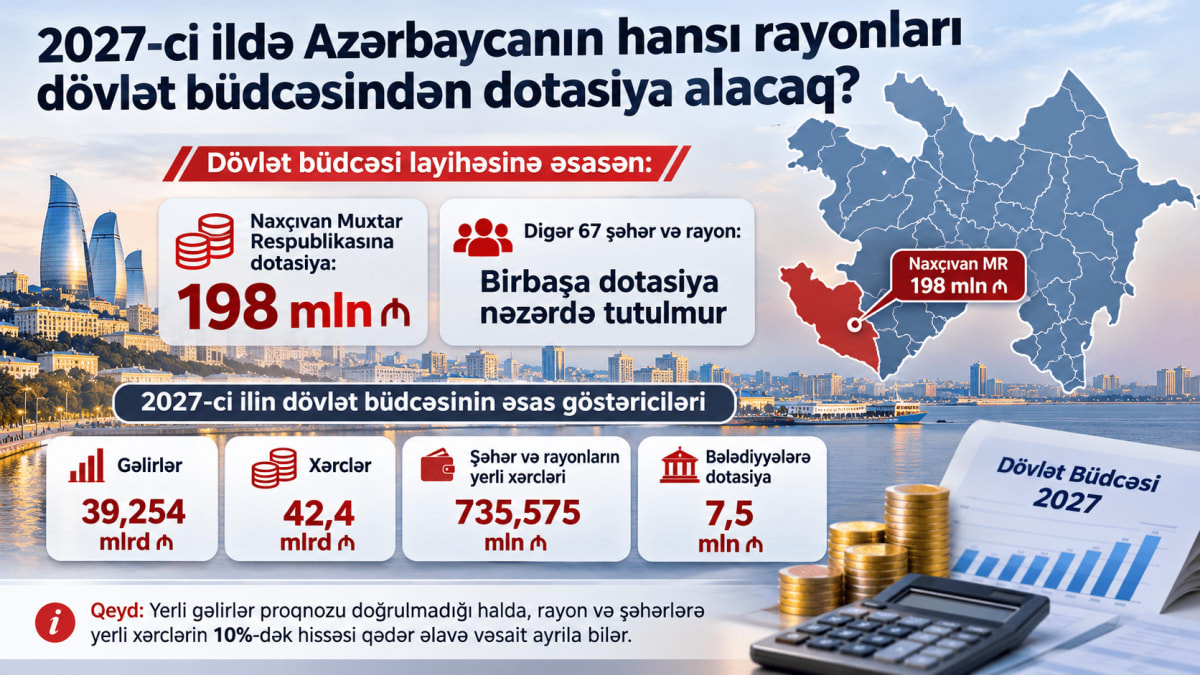
. Under the draft law “On the 2027 State Budget of the Republic of Azerbaijan”, none of the country’s 67 cities and districts is allocated a subsidy (dotation) from the state budget to cover its local expenditures next year. The only territorial unit that will receive a state budget subsidy is the Nakhchivan Autonomous Republic.
What does the draft say?
The draft budget for next year was submitted to the Milli Majlis (parliament) on 23 October 2026. It projects state budget revenues of 39.254 billion manats, expenditures of 42.4 billion manats and a deficit of about 3.15 billion manats.
The figures for cities and districts are as follows:
• Revenues: 18 billion 430 million manats
• Local expenditures: 735 million 575 thousand manats
• Subsidy: none planned
In other words, the local expenditures of every city and district must be paid for from revenues collected in its own territory. The part of revenues exceeding local expenditures will be transferred to the centralised revenues of the state budget.
How has the number of subsidised districts fallen?
Subsidies to districts were not stopped overnight; they have been reduced step by step in recent years:
Year
Districts receiving subsidies
Amount (approx.)
2022
14 districts
39.9 million manats
2023
8 districts: Jabrayil, Kalbajar, Lachin, Lerik, Khojaly, Khojavend, Yardimli, Zangilan
12.3 million manats
2025
a few districts
about 5.3 million manats
2026
Khojavend only
about 847 thousand manats
2027 (draft)
none
0
Khojavend was the last district to receive a subsidy, in 2026. Under the new draft, its local revenues will equal its expenditures in 2027, so it will not be allocated separate funds.
The only exception: Nakhchivan
The Nakhchivan Autonomous Republic’s budget is set to receive a 198 million manat subsidy from the state budget in 2027. This is 6.4% less than the approved 2026 figure and about 0.5% of total state budget expenditures. With this, the subsidy to the autonomous republic falls to its lowest level in recent years.
For comparison: Nakhchivan was allocated 431.6 million manats in 2022 and 336.5 million manats in 2024.
Municipalities are a separate matter
The end of subsidies to districts concerns the expenditures of local executive authorities. Subsidies and subventions from the state budget to municipal budgets remain a separate budget line. Economist Natig Jafarli also stresses that municipalities receive subsidies every year and will receive them this year too.
What do experts say?
Supporters. MP Vugar Bayramov says the step was expected: in his view, subsidies had been reduced consistently in recent years, while regional development creates local revenue sources and frees state funds for other sectors. Ruslan Atakishiyev, chairman of the Public Union for the Study of Economic Resources, believes self-financing will give local bodies a stronger incentive to collect revenue and will strengthen budget discipline. Vugar Oruj, chairman of the Azerbaijan Society of Appraisers, calls it a positive step for the financial independence of the regions, but notes that the main goal is to turn the regions into economic centres that attract investment.
Economic expert Emin Garibli says districts differ in revenue potential, and some may transfer more funds to the state budget in the future. He also proposes a public rating of district heads based on how well they plan revenues and expenditures.
Those raising questions. Natig Jafarli, however, questions what a “self-sufficient district” really means. His argument is that taxes, fines, licences and fees are centralised, and that the salaries of teachers, judges and law-enforcement staff, as well as major road, bridge and building projects, are financed from the central budget. He asks what independent revenue the districts will live on, and expects the Ministry of Finance and the Cabinet of Ministers to explain this to the public.
What does this mean in practice?
In the budget system, a district’s “local expenditures” are a small part of total spending: against 18.4 billion manats of revenue from cities and districts, local expenditures total just 736 million manats. Because education, healthcare, social payments and major infrastructure projects are financed mainly from centralised expenditures, ending the subsidy does not mean these services will be cut for residents. The change mainly increases the responsibility of local executive bodies for collecting revenue in their territories and planning their spending.
Next steps
The draft is not yet final. On 2 November the Chamber of Accounts approved its opinion on the draft and sent it to the Milli Majlis. The budget will now be discussed in parliamentary committees and plenary sessions, and the figures may change before final adoption.