Russian Diesel for the US: Experts Don’t Expect a Major Impact on Prices
Energy policy experts believe that an agreement on supplying Russian diesel to the US will not significantly lower fuel prices.
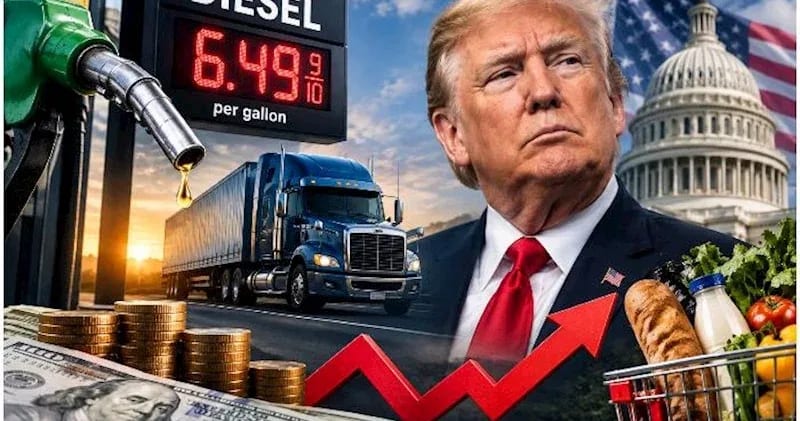
Energy policy experts believe that an agreement on supplying Russian diesel to the US will not significantly lower fuel prices.
US President Donald Trump announced on Friday that he had reached an agreement with Vladimir Putin on diesel supplies. Initially, more than 300,000 tons will be delivered immediately, followed by an additional 500,000 tons in November, and then 4 million tons. This marks a sharp reversal of US policy, as Washington has banned imports of Russian oil since the beginning of the war, and comes at a time when global oil prices are rising due to the eight-month US-Iran war.
Diesel Prices at Record Highs
According to AAA, the average price of a gallon of diesel hit a record $6.53 on September 22. On Friday, the figure stood at $6.28 (compared with $3.68 a year ago). Prices are also at record levels in Europe.
More expensive diesel raises freight and delivery costs, which in turn affects the prices of everyday goods. Some companies have already introduced surcharges on online orders and postal shipments. Perishable goods such as meat and produce are especially affected. According to an AP-NORC poll, rising prices have pushed Trump’s approval rating on the economy to a new low, which is a sensitive issue for Republicans ahead of the November 3 midterm elections.
Experts Are Skeptical
Michael Lynch, a researcher at the Energy Policy Research Foundation, compared the deal to “rearranging deck chairs on the Titanic.” According to him, if the US buys diesel from Russia, its previous customers will look for other sources, and the price will remain roughly the same. At best, a slight decrease is possible in regions such as New York–New Jersey and Philadelphia.
Daniel Sternoff of Columbia University’s Center on Global Energy Policy noted that Russia banned diesel exports in July due to Ukrainian drone strikes on its refineries; a resumption of exports could help stabilize global prices. However, because of disruptions in the Strait of Hormuz, a large share of Middle Eastern refining capacity cannot reach the market, and the supply of refined products is about half of its pre-war level. As a result, prices may fall slightly but will not drop significantly.
Moscow May Be the Main Winner
Clayton Seigle, an expert at the Center for Strategic and International Studies, believes Russia will benefit the most from the deal. In the coming months, Moscow needs heavier winter-grade and Arctic-grade fuel, so it wants to unload its summer-grade diesel stocks. In Seigle’s view, this will not noticeably lower prices in the US and Europe, but it will ease Moscow’s revenue squeeze.