From "White Gold" to Added Value: The Tashobasi Cotton Processing Plant in Sabirabad
Reviving cotton farming in Azerbaijan is not only about growing raw material. State policy aims to process raw cotton locally and create added value. The cotton processing plant of "Tashobasi" LLC in the Sabirabad Industrial District is one regional example of this approach.
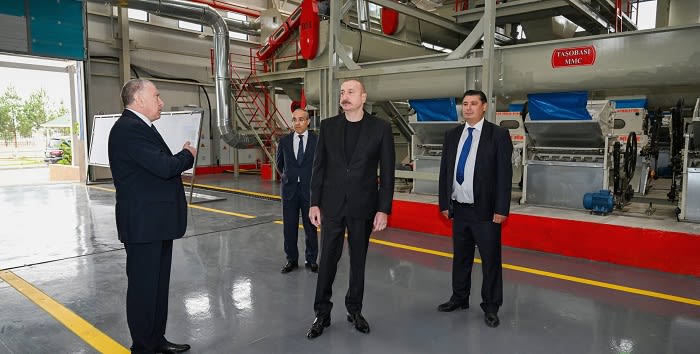
Reviving cotton farming in Azerbaijan is not limited to producing raw material. The aim of state policy is to process raw cotton locally and create added value. The cotton processing plant of "Tashobasi" LLC in the Sabirabad Industrial District is one regional example of this approach.
The plant in numbers
"Tashobasi" LLC was registered in 2023 as a resident of the Sabirabad Industrial District. The plant produces lint and technical cottonseed using technologies from Türkiye, Germany and Italy. President Ilham Aliyev toured the plant on October 28, 2025. The key indicators presented that day were:
The total project value is 3.3 million manats. Annual production capacity is 8,000 tons of lint and 10,000 tons of technical cottonseed.
Products worth 2.6 million manats have been sold to date, of which 2.2 million manats were exports.
80 permanent jobs have been created at the plant. In the cotton fields, which supply the raw material, 300 people have seasonal work.
A few simple calculations can be made from these figures (these are my own calculations, not official indicators):
Exports account for roughly 85% of sales (2.2 / 2.6).
The value of products sold equals roughly 79% of the investment.
Investment per permanent job is roughly 41,000 manats (3.3 million / 80).
Counting permanent and seasonal workers together, the plant supports the livelihoods of roughly 380 people.
A regional raw-material chain
The plant uses cotton grown in the Neftchala, Salyan, Sabirabad and Saatli districts. Its impact is therefore not limited to a single district. It links farmers in four districts of the Lower Kur-Mugan-Shirvan zone into one supply chain. Farms growing cotton sell their produce locally, transport costs fall, and processing is carried out by local labor.
The industrial district in context
The Sabirabad Industrial District was established by a Presidential Decree dated November 27, 2017. The incentives granted to residents are as follows:
Residents are exempt from property, land, and income or profit taxes for 10 years from the date of registration.
Machinery and equipment they import for production purposes are exempt from VAT and customs duties.
The district's recent results are also dynamic. In January–June 2026, products worth 3.3 million manats were produced in the district, more than triple the figure for the same period of the previous year. Residents have invested a total of 11.8 million manats and more than 100 jobs have been created. "Tashobasi" is one of the largest residents of the district. Its project value accounts for a significant part of the investment recorded there. To calculate the exact share, both indicators would need to refer to the same date, so I am not calculating it here.
Link to the President's economic development policy
"Tashobasi" sits at the intersection of three strategic directions.
1. Development of the non-oil sector and industrialization. Industrial parks and districts are among the main tools of this policy. According to the head of state, the country has 7 industrial parks and 5 industrial districts (Hajigabul, Masalli, Neftchala, Sabirabad and Sharur). Residency status has been granted to 134 business entities in industrial zones, and 68 of them have started operating. The Sabirabad district is the regional link of this network.
2. Reviving cotton farming. At the opening of the cotton-polyester factory in the Mingachevir Industrial Park, the President made this connection explicit. In his words, these factories would not have appeared had cotton farming not been seriously revived, because importing raw cotton from abroad and spinning it into yarn here would have been very expensive. The head of state also said at that time that cotton production had risen from 35,000 to 207,000 tons within two years. "Tashobasi" provides the primary processing stage of this chain. After the plant, lint goes to spinning and textile enterprises, and cottonseed goes to oil production.
3. Regional employment and exports. The plant's 80 permanent and 300 seasonal jobs and its 2.2 million manats of exports are directly tied to these goals. One of the stated aims of industrial policy in Azerbaijan is to increase the share of industry in employment and to create jobs outside the capital.
Assessment
The figures show that the project is genuinely operating. Several points, however, need clear explanation.
The plant's annual capacity is 8,000 tons of lint and 10,000 tons of cottonseed. The value of products sold so far (2.6 million manats) looks well below what would be expected from a fully loaded plant. This may be because the sales figure is cumulative since the plant began operating and covers a short period, or because the plant is still ramping up. Official data should show which explanation is correct.
Cotton processing is a seasonal sector. Permanent jobs are stable, while seasonal jobs exist only during the harvest.
The tax incentives last 10 years. The plant's long-term sustainability will depend on it remaining competitive after that period.
"Tashobasi" is a relatively small project, but it combines a traditional agricultural sector such as cotton with industrial processing. The investment combines foreign technology with local raw material, and a significant part of the output is directed to export. Projects like this are the Sabirabad-level result of the President's policy on industrial districts, the restoration of cotton farming, and regional employment.