One Rooted Tree, Two Branches: No Force Can Shake This Brotherhood
History sometimes doesn’t open a notebook and write documents to bring peoples closer.
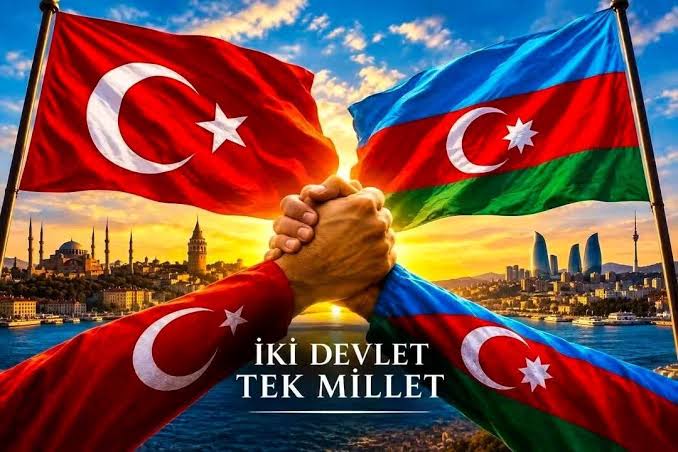
History sometimes doesn’t open a notebook and write documents to bring peoples closer. It simply leads them through the same grief and around the same joy. Azerbaijan and Turkey are such peoples. No protocol created their friendship. This friendship grew in the blood, in the language, in lullabies, in bayatis, in shared mourning and shared weddings.
That is why the voices that rise from time to time saying “this relationship will cool” or “a shadow will fall between them” always remind me of the same scene. A man stands on the seashore, scatters sand onto the beach, and imagines he can stop the wave.
The Meaning of a Meeting
On 8 November 2026, Recep Tayyip Erdoğan visited Azerbaijan. At Fuzuli airport he was welcomed by Ilham Aliyev and his wife Mehriban Aliyeva. Then the leaders set off for Shusha. The visit coincided with the eve of the anniversary of Victory Day.
Diplomatic protocol calls such visits “official.” But the human eye sees more than protocol. It sees the warmth at the airport, the flowers, the look between host and guest. In official meetings, the hardest thing to fake is precisely this: sincerity. It is either there or it isn’t.
Here, it was there.
“One Nation, Two States”
This phrase, which came from Heydar Aliyev, has already become a slogan. But most slogans are forgotten once they have been spoken. This one was not forgotten, because real life stands behind it.
The history of this phrase goes back a long way. In 1991, Turkey was among the first countries to recognize Azerbaijan’s independence. At that time Azerbaijan was still a young state, its borders were being tested, and its future looked dark. At such times, a hand extended by a friend is never forgotten.
The years that followed turned this friendship from a slogan into concrete work. The oil and gas pipelines stretching from the Caspian to the Mediterranean, the Baku–Tbilisi–Kars railway, and energy and transport projects showed that the two countries were not content merely to stand side by side on the map; they could also walk side by side. Here, brotherhood turned into iron, concrete, and pipelines.
A Friend Is Known in Hard Times
A folk proverb says: a friend is known in hard times. This proverb has been tested twice in the history of the two peoples.
The first test was the autumn of 2020. In the 44-day Patriotic War, Azerbaijan was trying to heal the wound of thirty years. In those days, the Azerbaijani flag waved in the streets, squares, and homes of Turkey. In Istanbul, Ankara, and Izmir, people rejoiced just as they did in Baku. Because this was not a “neighbor’s” victory but the victory of “our own home.”
The second test came in February 2023. A terrible earthquake devastated southern Turkey. This time the road stretched from Baku to Turkey. Azerbaijan’s rescuers, doctors, and volunteers worked day and night amid the ruins of Anatolia. It is well known that Azerbaijan was one of the countries that sent the largest aid to Turkey in this disaster. But something more valuable than statistics was this: when the aid arrived, the people of Turkey received it not as “foreign aid” but as a brother’s hand.
The degree of friendship is measured in these two moments: one in joy, one in sorrow.
Shusha: Memory Turned to Stone
15 June 2021. Shusha. The two heads of state signed the Declaration on Allied Relations.
The chosen location was no accident. Shusha is the heart of Azerbaijani culture, the cradle of music, poetry, and mugham. Signing a document in this city meant that this friendship is bound not only by political calculations but also by cultural memory. The alliance was born not of “necessity” but of “kinship.”
The Declaration gave these relations a new, formal framework. But to be honest, the document merely confirmed what already existed. The friendship was there before, and now it also has written proof.
What Can “Forces” Do?
Now let’s speak openly. Every brotherhood has its “well-wishing” observers. Some look for differences between the two, some present every differing opinion as a crack, and some count every silence as coldness. Fabricated news, sentences torn out of context, and inaccurate commentary circulate on social media. The goal is clear: to sow the seed of doubt.
But this strategy has a fundamental weakness. Doubt grows only on a weak foundation. And here the foundation is strong.
The two states may show different approaches on some issues. It would be strange to deny this. Every country has its own geography, its own interests, its own diplomacy. But true alliance does not mean agreeing on every issue. True alliance means not allowing differences of opinion to break the friendship. Brothers in a family don’t agree on everything either, but that doesn’t cancel their brotherhood.
Moreover, this brotherhood has gone beyond the personal relations of leaders. Leaders may change, governments may change, but the lullaby sung to a child by a mother in Baku and a mother in Konya will still sound in the same language. No “force” can change the memory of a people.
A Trust for Tomorrow
I look at this friendship not as nostalgia but as a trust handed down to us. Three things are contained in this trust.
First, memory: not forgetting the shared story of Çanakkale and Shusha, of Nuru Pasha and the veterans of Karabakh.
Second, honesty: keeping the friendship alive not only in speeches but in deeds, in projects, in youth exchanges, in trade, and in education.
Third, vigilance: looking not at the words of those who want to shake the friendship, but at the real relationship between the two peoples.
If these three things are preserved, no outside voice, no fabrication, no manipulation can bring this bridge down.
Final Word
A tree’s trunk is one, while its branches may stretch in different directions. But its root is in the same soil. Azerbaijan and Turkey are the same. Whatever they do, no one will be able to separate these two branches from each other, because what binds them is not political calculation. They are bound by one blood, one language, one memory, and a little of that mysterious something: a kinship that words cannot explain.
And history shows this once again each time: the fate of this brotherhood is decided not by those who speak of it from outside, but by those who live it.