South Korea’s Kospi Index Falls 7.4% as Investors Worry About the AI Market
South Korea’s benchmark stock market index, the Kospi, fell 7.4% amid mounting selling pressure on semiconductor manufacturers’ shares. Concerns over intensifying competition in the artificial intelligence sector have also reinforced negative sentiment across Asian markets.
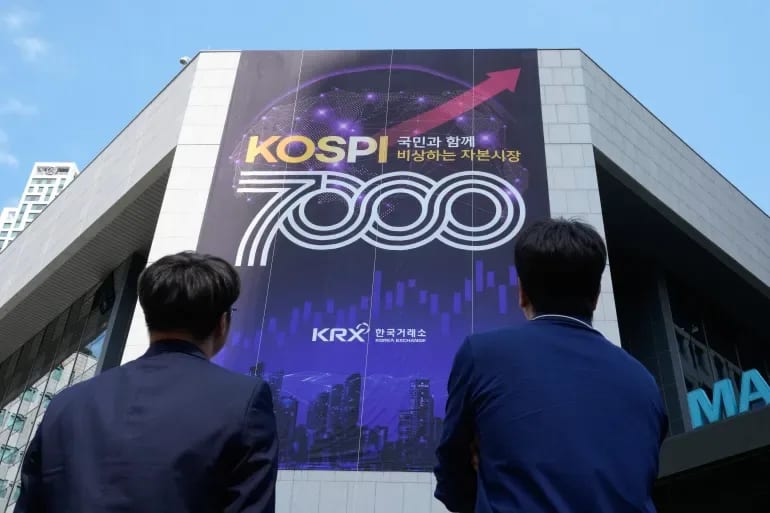
South Korea’s benchmark stock market index, the Kospi, fell 7.4% amid mounting selling pressure on semiconductor manufacturers’ shares. Concerns over intensifying competition in the artificial intelligence sector have also reinforced negative sentiment across Asian markets.
According to the Associated Press, the Kospi fell to 5,914.35 points, its lowest level since late July. The decline was mainly attributed to falling shares of major chipmakers such as Samsung Electronics and SK Hynix.
Samsung Electronics shares lost 7.7%, while SK Hynix shares fell 8.8%. Investors are concerned that advances made by China’s memory chipmaker CXMT could intensify competition in the global market. This could put pressure on the market positions of Samsung Electronics, SK Hynix and US-based Micron Technology.
Major Asian stock markets also recorded declines. Japan’s Nikkei 225 fell 2.5% to 67,292.39 points. Shares of Tokyo Electron dropped 6.6%, while SoftBank Group shares declined 8%. Hong Kong’s Hang Seng Index fell 1%, and the Shanghai Composite Index dropped 1.1%. Taiwan’s Taiex declined 1.9%, while Australia’s S&P/ASX 200 fell 0.2%. TSMC shares also lost 1.6%.
US stock markets recorded modest declines in the previous trading session. The S&P 500 fell 0.1%, while both the Dow Jones Industrial Average and the Nasdaq declined 0.4%. Nvidia shares dropped 1.3%, AMD fell 2.3%, Micron Technology declined 3.9%, and Broadcom lost 1.9%.
Investors are also focusing on financial results from major US banks due to be released this week. Reports from Citigroup, JPMorgan Chase and Wells Fargo are expected to influence market expectations.
Oil prices also declined in commodity markets. Brent crude fell 1.4% to $105.20 per barrel, while US West Texas Intermediate (WTI) crude dropped 1.5% to $92.34 per barrel. Nevertheless, prices remain elevated compared with levels before the war involving Iran.
ING commodity market strategists Warren Patterson and Eva Manthey said market participants were closely monitoring recent developments in the Middle East, Houthi attacks on Saudi Arabia, and risks to oil supplies through the Persian Gulf.
In currency markets, the US dollar weakened from 158.61 yen to 158.26 yen. The euro rose from $1.1155 to $1.1175.
The declines across stock markets highlight how uncertainty surrounding the sustainability of rapid growth in the AI sector, competition among semiconductor manufacturers and geopolitical risks is influencing investor decisions.