Public Transport in Azerbaijan: Progress in Statistics, Problems on the Roads
Every year, record figures are announced, and every quarter brings reports of "growth."
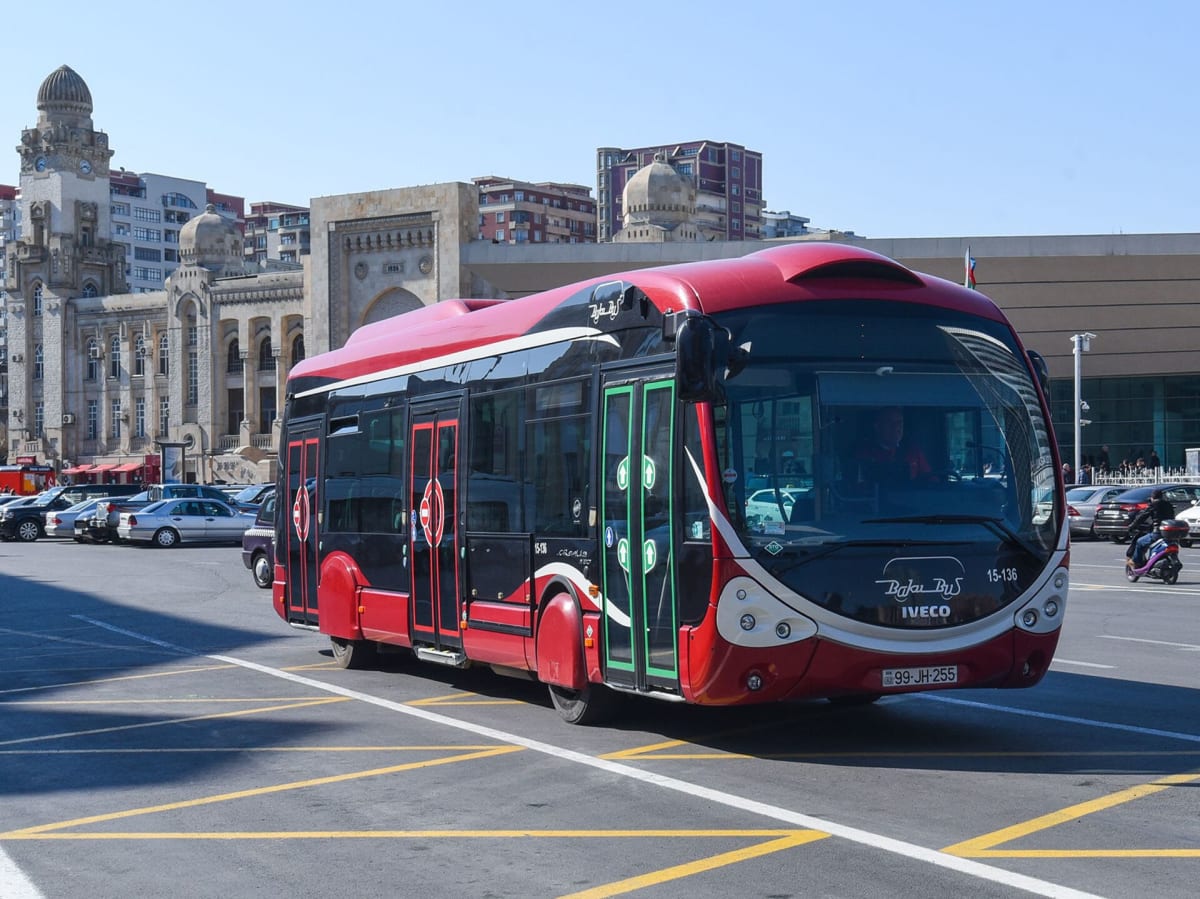
Every year, record figures are announced, and every quarter brings reports of "growth." But when a passenger steps off a bus, waits for a taxi, or tries to find a seat on a regional route, they see how little those figures affect their day. The question is simple: why do the violations in this sector persist year after year, and who is responsible?
The figures are impressive; daily experience is different
According to official data, in the first quarter of 2026 buses in Baku carried roughly 120 million passengers, and more than 2,350 buses operate on the capital's route lines every day. In September 2022 that number was 1,780; by 2025 it had reached 2,340. The growth is real and worth acknowledging.
But the question is this: if the number of passengers and buses is rising, why are service quality and compliance with the rules not improving at the same pace? A record passenger count is not an indicator of service quality; it may simply be an indicator that people have no other choice.
Rule violations are not the exception; they are a recurring pattern
Sumqayit: drivers without the right license category, extra seats, passengers above the limit. During a raid in the city, cases were found of buses being driven without the appropriate license category, extra seats being installed in vehicles, and more passengers being taken than allowed. Protocols were drawn up and vehicles were taken to the impound lot. The most striking part, however, is the driver's explanation: according to him, people board because there are not enough vehicles, and it is impossible to make them get off. In other words, the violation is presented not as individual "willfulness" but as a systemic gap created by a service that falls short.
Zaqatala (27 September): police and AYNA officers who were checking carriers' compliance with the law brought to administrative responsibility those who committed violations and those who had no right to drive vehicles of the relevant category. The announcement stresses that "measures in this area continue to be carried out regularly." If regular measures are needed, the problem must be recurring regularly.
Baku, route 211: a dispute arose between a driver and a passenger over a child's scooter. After an investigation, Baku Bus LLC admitted that the driver had not correctly applied the rules in force on carrying hand luggage. In other words, the driver does not know, or does not apply, the rules of his own job, and the passenger is left to prove the rule herself. In such a case, knowing the law is the carrier's duty, not the passenger's.
Sabunchu: according to media reports, a bus driver committed an act of petty hooliganism against a female passenger. Here the issue is less about transport rules than about a passenger's basic sense of safety.
The taxi market: "legalization" is still ongoing
According to AYNA, more than 40,000 permit cards have been issued for vehicles in Baku, while about 23,000-24,000 taxis go on the line each day. On this basis, the agency says there are too many taxis on the market. At the same time, it is known that passenger transport without a "distinguishing mark," which confirms that tax and social obligations have been met, is prohibited, and that taxi dispatch operators are gradually restricting carriers without such a mark. The media outlet that published the report also writes that the market is currently going through a legalization process.
This raises an open question: if the market is being legalized only now, how was a large part of it allowed to operate outside the full rules for so many years? Moreover, enforcement relies not on state oversight but mostly on the internal restrictions of ride-ordering platforms. The agency itself says that no special raids are conducted over the absence of this mark. In other words, oversight has largely been left to the market's own mechanism.
Laws change often; the result stays the same
In 2026 alone, within just a few months of each other (decisions of 15 May and 31 July), the Cabinet of Ministers made new amendments to the passenger transport rules and to the methodology related to tariffs. The regulatory framework is being updated, but there is no open, measurable indicator of how these changes are reflected in the passenger's daily experience.
The real problem: no measurable accountability
During this research, no aggregate violation statistics for the sector, no number of complaints and rate of their resolution, and no report on fines and license revocations were found in open sources. That in itself is a critical fact: what society does not measure is hard to improve. In the news, only individual raids and incidents are visible.
Answering "When will it stop?"
The honest answer: the sector will not change through raids and fines alone. Until the following are done, news of new "raids" will keep recurring:
Open statistics: quarterly reports should publish not only passenger numbers but also the number of violations, complaints, fines, and license revocations.
Carrier responsibility: when a driver does not know or breaks the rules, the carrier that hired him and put him on the route should be held accountable alongside him.
Supply-demand balance: the "there are not enough vehicles" excuse, as in the Sumqayit example, must end. Until enough buses and routes are provided, violations turn into an economic necessity.
A simple passenger complaint mechanism: a passenger who files a complaint should see the outcome, and it should not go unanswered.
Continuous oversight in the regions: permanent and predictable inspection instead of campaign-style raids.
The official side's position
For balance, it should be noted that official bodies justify a different view: AYNA states that the bus fleet is expanding steadily, passenger flow is growing, the taxi market is being legalized, and oversight measures are carried out regularly. In the agency's view, there is no limit on the number of taxis and demand is fully met; waiting times may lengthen only at peak hours. Supporters of this answer stress that violations are isolated cases and that the overall trend is positive. The real dispute begins here: to verify which side is right, open, independently verifiable data is needed.