Nvidia turmoil rattles markets as Asian tech stocks tumble
Jensen Huang’s resignation deepens doubts over the AI boom. Taiwan’s benchmark sank 6% and South Korea’s fell 3.6%.
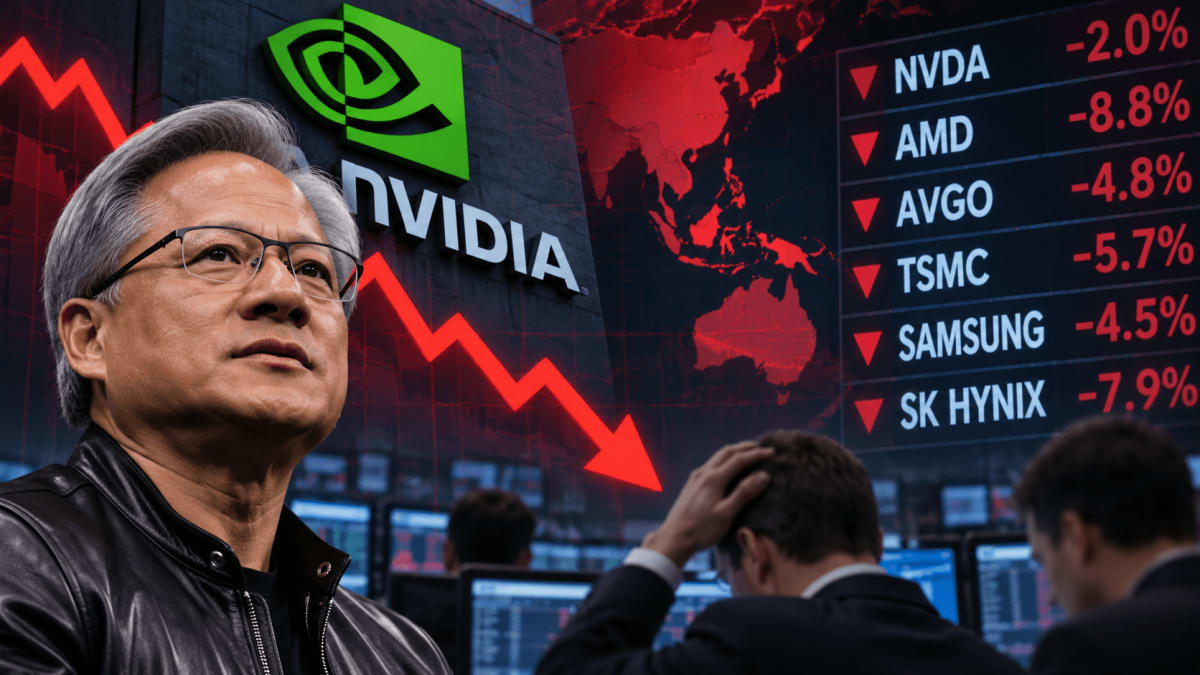
Jensen Huang’s resignation deepens doubts over the AI boom. Taiwan’s benchmark sank 6% and South Korea’s fell 3.6%.
The leadership shake-up at Nvidia weighed on global markets for a second week. On Monday the sell-off in Asian technology shares continued, while European indexes opened slightly higher. U.S. stock futures were also trading lower, according to AP.
Investors are watching two events closely: Nvidia reports quarterly earnings on Tuesday, and Anthropic is set to make its stock market debut later in the week. Traders see both as key signals for the future of the AI industry.
Huang’s exit and its fallout
Jensen Huang stepped down as Nvidia’s chief executive last week after an extramarital affair raised U.S. national security concerns. Huang had long been one of AI’s most prominent champions, and his departure has raised questions about where the global AI boom goes from here.
Nvidia shares fell 4.3% on Thursday, when the resignation was announced, and lost another 2% on Friday. Rivals also slid: Broadcom fell 4.8% and AMD dropped 8.8% on Friday.
Chipmakers hit hardest in Asia
The sell-off was sharpest in markets dominated by AI hardware makers:
Taiwan: The Taiex fell 6%. Shares of TSMC, the world’s leading chipmaker, lost 5.7%.
South Korea: The Kospi fell 3.6% to 5,100.50. SK Hynix and Samsung Electronics, the country’s two most valuable companies, fell 7.9% and 4.5% respectively.
Japan: The Nikkei 225 fell 2.4% to 59,662.02. Official data released the same day showed Japan’s economy contracted last quarter. OpenAI investor SoftBank Group fell 3.7%, memory chipmaker Kioxia fell 7.7% and chip equipment maker Tokyo Electron fell 7.1%.
Elsewhere in the region, results were mixed. Hong Kong’s Hang Seng rose 0.5% to 23,753.84. The Shanghai Composite slipped 0.9% to 3,602.57 after China’s retail sales and industrial output data, released Monday, disappointed analysts. Australia’s S&P/ASX 200 fell 0.4% to 9,044.70, while India’s Sensex gained 0.6%.
“The risk has become more serious”
Analysts say concerns that growth in AI capital spending could slow were building even before the Nvidia news. Uncertainty over AI data center development in the U.S. had also been rising after the midterm elections.
Zhiwei Zhang, president and chief economist at Pinpoint Asset Management, said the market was already worried about this risk before the events at Nvidia, and that the risk has now become more serious.
Europe and Wall Street
European trading opened with modest gains. Britain’s FTSE 100 rose 0.3% to 10,935.36 and France’s CAC 40 gained 0.3% to 8,390.11. Germany’s DAX edged up less than 0.1% to 26,756.19.
On Friday, the S&P 500 fell 0.4% and the tech-heavy Nasdaq dropped 0.9%. The Dow Jones Industrial Average rose 0.1%.
Oil and currencies
Oil prices held steady. Tensions in the Middle East continue, but oil exports from the Gulf are returning to pre-war levels. Last week the International Energy Agency said Gulf exports are recovering faster than global oil demand.
Brent crude fell 0.3% to $95.55 a barrel. That is well above the roughly $72 it cost in late February, before the Iran war began.
The U.S. dollar was little changed at 159.61 Japanese yen. The euro slipped from $1.1029 to $1.1014.
On Wednesday, the Federal Reserve will release the minutes of its latest policy meeting. They may show in more detail how the Fed makes interest rate decisions while trying to bring inflation down.
On Thursday, the Asia-Pacific Economic Cooperation (APEC) summit opens in Shenzhen, China. U.S. President Donald Trump, Chinese leader Xi Jinping and Russian President Vladimir Putin are expected to meet there.