China is raising a generation that grows up with AI
China wants every schoolchild to be AI-literate by 2030. The country is running one of the world’s largest education experiments, but the results so far are mixed.
China wants every schoolchild to be AI-literate by 2030. The country is running one of the world’s largest education experiments, but the results so far are mixed.
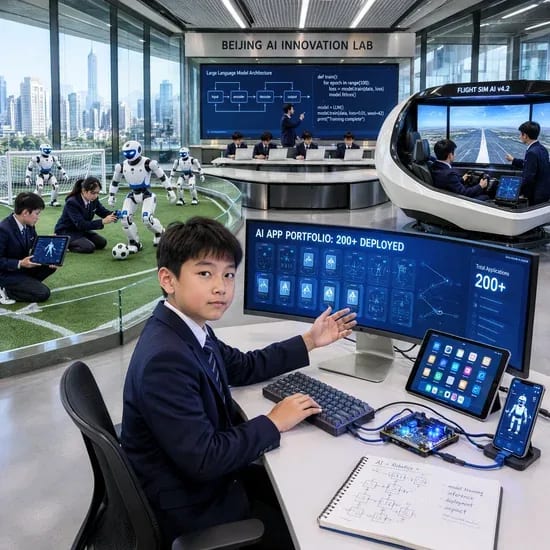
Peng Gaodi, 13, attends one of Beijing’s most prestigious private schools. With the help of artificial intelligence, he has already built more than 200 apps, including a homework platform and a second-hand marketplace. He pitches his ideas to real investors, says he admires Elon Musk, and hopes to become a computer scientist.
His classmates program humanoid robots to play football, take part in coding workshops and train on flight simulators. Posters across the 12-hectare boarding campus urge students to use “vibe coding” to “build a virtual world in five minutes.”
“Before, if I couldn’t solve a problem at home, I had to call my teacher, which added to their workload. Now I can just ask AI to help me learn better. It has greatly improved my learning efficiency,” Peng said.
Beijing New Talent Academy charges $39,000 a year in tuition. It gave Reuters rare access. The school has more than 2,000 students and has designed its own digital innovation curriculum covering AI, robotics and programming. It has also built its own classroom AI model, which combines features of well-known Chinese systems.
The school is at the forefront of a much broader shift. About 200 million students attend primary and secondary schools in China. As AI becomes part of teaching across the country, China is running one of the world’s largest AI-assisted learning experiments.
Beijing wants AI literacy to be universal among schoolchildren by 2030. Under current guidelines, students should start by grasping basic concepts at a young age. Later, they should learn to use advanced tools and think critically in complex projects.
Reuters spent several weeks reporting this story. Its reporters visited schools, interviewed dozens of teachers, parents and experts, and reviewed more than 100 academic papers and government procurement records. The result is one of the most detailed pictures yet of how AI is changing Chinese classrooms. The investigation found a sweeping but uneven drive to raise a generation of AI-savvy innovators. There is still little agreement on what AI literacy means, how to teach it or how to measure it.
China sees AI as central to its economic future and to its technology race with the United States. Beijing hopes that introducing children to the technology early will build the homegrown innovation needed for major breakthroughs.
A state plan far ahead of the West
China’s state-led push goes far beyond what Western countries are doing. President Xi Jinping has called AI education a cornerstone of reform. According to Stanford University’s 2026 AI Index, the United States relies on decentralised, voluntary guidance. It has no dedicated funding and no state-level standards for teachers.
Reuters analysed provincial “AI + Education” plans. The analysis found a level of official coordination not seen elsewhere. About half of China’s provinces and major cities have adopted mandatory plans:
Shanghai requires at least 30 hours of AI instruction a year in every grade.
Beijing’s city government plans to use AI to monitor student health and to set up 100 pilot schools.
Regions such as Ningxia and Gansu plan to include AI knowledge in high-stakes school entrance exams by 2027.
The documents also show how AI may be used more widely in classrooms. Besides coding and tutoring, Guizhou province is installing facial recognition and behaviour analysis systems in classrooms. Shanghai is rolling out systems that track students’ mental and physical health. In Yunnan, lessons in 14,000 classrooms are to be recorded and analysed by AI. All of this makes Chinese schools a major testing ground for the opportunities and risks facing education worldwide.
As AI spreads through classrooms, many teachers are in a difficult position. They are trying to adopt the technology without reinforcing the rote-learning habits that policymakers want to leave behind.
Reuters found very different approaches across the country. Some schools encourage students like Peng to build and create with AI. Others use the technology mainly to fill gaps in teaching resources.
Ted Mo Chen, chief executive of Chinese edtech company ClassIn, said implementation is “all over the place.” Only a few of the schools he has visited have integrated AI into the curriculum effectively, he said.
China’s Ministry of Education did not respond to a request for comment.
Classrooms of the future
At Beijing New Talent Academy, only a small share of students will become AI scientists or engineers, said principal Liu Wei. For the rest, the goal is to use AI as an everyday tool for learning and creativity.
Hundreds of kilometres from the capital, Qingqing High School in rural Funan County, Anhui province, uses the same technology for a different purpose. It is trying to solve a problem that wealthy cities rarely face: a shortage of qualified teachers.
Principal Yang Tianlian said the school’s 4,000 students, most of them children of migrant workers, learn core subjects through AI-generated lessons. Students follow personalised lessons on tablets. When they struggle, AI agents ask guiding questions instead of giving them the answer.
“An AI agent never gets tired. It never makes a student feel stupid for asking a simple question,” Yang said.
The school uses Alibaba’s Qwen and models from ByteDance and Z.AI to create text, images, interactive lessons and videos. Yang said the school has also introduced small-group projects to encourage more interaction among students.
According to Yang, this approach has helped raise the school’s university admission rate from 60% to 90% in recent years. Reuters could not independently verify these figures. Yang estimates that at least 200 Chinese schools are testing similar systems.
An Alibaba spokesperson said the company’s open-source models and its Cloud Program for Youth give students direct access to AI tools and educational resources. ByteDance and Z.AI did not respond to requests for comment.
Millions of dollars in investment
Schools like Qingqing show how quickly AI is spreading through China’s education system. Since 2024, the Ministry of Education has encouraged schools to introduce AI courses, train teachers and set up pilot programmes. Primary school pupils are introduced to basic AI tools. Older students learn how AI systems work and apply them in increasingly complex projects.
Reuters reviewed more than 100 government procurement documents. They show that authorities spent at least $31 million on AI classroom equipment and on training and teaching platforms over the past year.
The real figure is likely much higher, because spending is spread across thousands of local budgets and is not officially totalled. Consultancy iResearch estimates that spending on education digitalisation was about $83 billion in 2025. It says generative AI projects account for 46% of AI education procurement.
An experiment without a clear yardstick
China has not yet created a standard framework for measuring AI literacy. This leaves schools free to experiment but makes it hard to judge success.
“Mature, widely accepted assessment rubrics for school-level AI skills are still being developed,” said Selena Guo, portfolio lead at research firm China Policy.
Early research on how AI affects children’s learning also gives mixed signals. Some studies point to short-term gains but raise questions about long-term intellectual development.
A recent study of about 27,000 Chinese teenagers linked AI use to an 18% rise in homework scores. Over six months, however, monthly exam scores fell by 20%. The steepest decline was in social science subjects.
A separate national survey of more than 320,000 students this year found educational benefits but also concerns about dependence and weaker independent thinking. Students who used AI at least three times a week scored lower on memory, comprehension, analytical and creative skills than those who used it less.
The findings do not prove cause and effect. But they add to teachers’ worries about “cognitive outsourcing,” in which children hand mental work over to technology instead of doing it themselves.
ClassIn’s Chen warned that if schools do not stop children from using AI for quick answers, their thinking process could be bypassed entirely.
Chinese academic research reviewed by Reuters also suggests that rural students may be especially vulnerable to cognitive outsourcing and device dependence.
Finding the right balance
Some teachers and parents are already trying out rules to keep AI from replacing critical thinking.
At Beijing New Talent Academy, Peng said he first tries to solve coding problems on his own and then asks AI only for hints, not full answers. He said the technology has helped him understand maths more deeply.
“For me, AI is a tool that helps me, not something I depend on,” he said.
Beijing resident Rita Luan has an 11-year-old daughter at one of the capital’s leading public schools. For Luan, the key question is whether AI strengthens learning rather than cutting it short.
Luan said her daughter’s school still teaches AI mostly as theory. So she adds lessons at home and, under close supervision, has taught her daughter to use ByteDance’s Doubao chatbot.
Her rule: spend 15 minutes working on a hard maths problem before turning to AI. A few days later, Luan asks her daughter to solve the same problem without help.
“The point is to make sure she has really absorbed the solution,” she said.
Source: Reuters