Farmers grow, middlemen profit: sales problems are emptying Azerbaijan's villages
In the regions, farmers are forced to sell their produce on the spot to middlemen at prices well below its value. This cuts production, destroys jobs and pushes people from villages to cities.
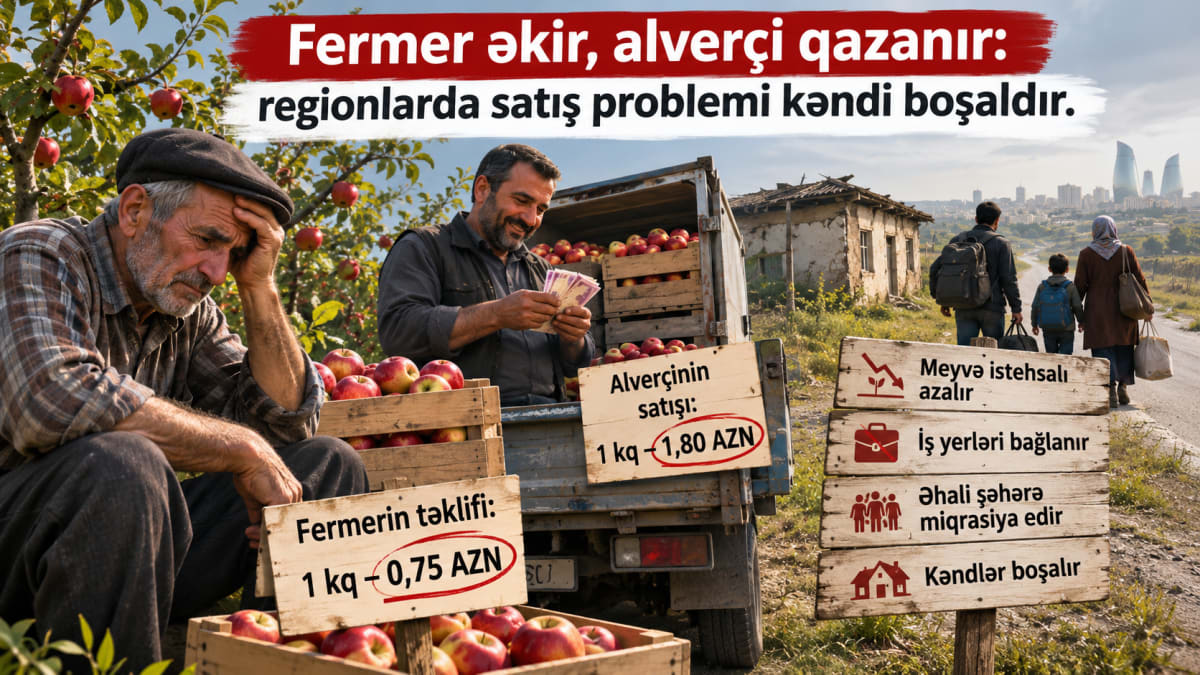
In the regions, farmers are forced to sell their produce on the spot to middlemen at prices well below its value. This cuts production, destroys jobs and pushes people from villages to cities.
How big is the price gap?
Onions. According to Day.az, farmers sell a kilogram of onions on the spot for about 60 qəpik (0.60 manat), while prices in the capital's markets range from 85 qəpik to 1 manat. Some farmers who lost money last year have refused to plant this year.
Aghdam. JAMnews reports that in the village of Mahrızlı a 35 kg sack of onions sells for 3-4 manat at the field, but costs at least 17 manat by the time it reaches Baku.
Hazelnuts. AZƏRTAC reports that in-shell hazelnuts sold for 6-8 manat per kg last year, but only 2.5-3 manat per kg on the spot this year. An economist attributed this to a bumper crop at home and on the world market.
Azadlıq Radiosu reports that some farmers, unable to sell their onions, urged people on social media to come and take them for free.
Causes
The problem is not only about middlemen. When a farmer has no cold storage, no transport of their own and no direct sales channel, the buyer dictates the price. Access to credit and agricultural insurance is difficult. When too many farmers plant the same crop, prices fall, planting drops the following year, and the cycle repeats.
Consequences
According to the minister, about half of employment in the regions comes from agriculture. The sector accounted for 5.9% of GDP in 2025. World Bank data put the rural share of the population at about 41%. Farmers who lose money cut back planting and fall into debt, and seasonal workers and service businesses lose income too. Sevil Mikayılova has said that stagnation in agriculture leads to labor shortages and emptying villages. For precise regional migration figures, readers should consult the State Statistical Committee.
What is the state doing?
Steps taken include product subsidies, a planned product certificate for farmers, direct-sales fairs such as "From Village to City", expansion of the processing industry and irrigation projects. However, farmers' complaints show that the gaps in the sales chain have not yet been fully closed.
Solutions
Cooperatives: small farmers pool and sort their produce and negotiate with wholesale buyers together.
Regional cold storage and collection centers: farmers are not forced to sell immediately.
Advance contracts with processors: volume and minimum price are agreed before planting.
Permanent direct-sales channels: farmers' markets, online ordering, and procurement from local farmers for schools and hospitals.
Price and market information: daily wholesale and retail prices published via a mobile app.
Planting planning and export support: surplus crops are prevented from crashing prices.
Accessible credit and insurance: simple procedures and local advisory services.