TÜME develops AI-powered autonomous agricultural machine
Turkey’s Agricultural Technologies Cluster (TÜME) has developed an autonomous agricultural machine powered by artificial intelligence.
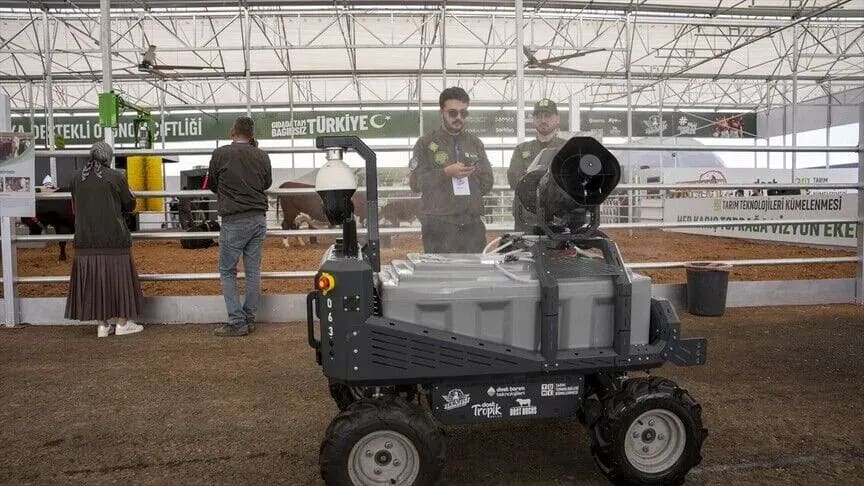
Turkey’s Agricultural Technologies Cluster (TÜME) has developed an autonomous agricultural machine powered by artificial intelligence.
The autonomous platform is designed for various agricultural activities, particularly pesticide spraying in greenhouses. The technology is being showcased at the Southeastern Anatolia stage of TEKNOFEST.
TEKNOFEST, with Anadolu Agency (AA) serving as its Global Communications Partner, is organized by Türkiye’s Ministry of Industry and Technology and the T3 Foundation and is being held at Şanlıurfa GAP Airport.
The autonomous platform showcased by TÜME can move without human intervention, perceive its surroundings through sensors, and perform various tasks using AI-based image-processing technologies.
Mehmet Fatih Özay, a TÜME representative, told AA that the aim is to reduce labor and resource costs in agriculture through the use of autonomous technologies.
According to Özay, the platform is equipped with an AI-supported autonomous system that can independently control its movement, perform calculations and make certain decisions.
Özay noted that pesticide spraying in greenhouses is a labor-intensive and costly process. He said the system provides an autonomous solution for this task.
He added that the platform can be equipped with various functions. Cameras and image-processing technologies make it possible to monitor the condition and development of plants.
According to Özay, the addition of a robotic arm would allow the system to be used for harvesting. Products can also be transported using boxes and other equipment placed on the platform.
Özay said the platform could also be used in livestock farming. With different attachments, the device can be adapted for transporting feed or calves.
The platform returns to the charging station after completing its tasks
Robotics engineer Ali Altın said the autonomous device was primarily designed for pesticide spraying in greenhouses.
According to him, since the use of drones in greenhouses is limited, an autonomous system equipped with cameras and sensors was developed.
Altın noted that the camera mounted at the front of the platform enables image analysis. The system can also be controlled via a mobile application.
He said users can determine when and how frequently the system operates. For example, the device can be programmed to spray every three hours.
Barış Şen, an employee of the Electronics and Mechanics Research and Development Department, said the team aimed to develop a platform that could be used for as many different functions as possible.
According to Şen, developing the software for the autonomous vehicle took approximately 2–2.5 months, while the mechanical design of the first prototype took about one month.
He added that the platform was completed within a short period as a result of the team’s joint efforts.