Carney: Canada may turn to Chinese automakers if US talks fail
Canadian Prime Minister Mark Carney says Canada could pursue partnerships with Chinese automakers if trade talks with Washington fail to protect North America’s integrated auto industry.
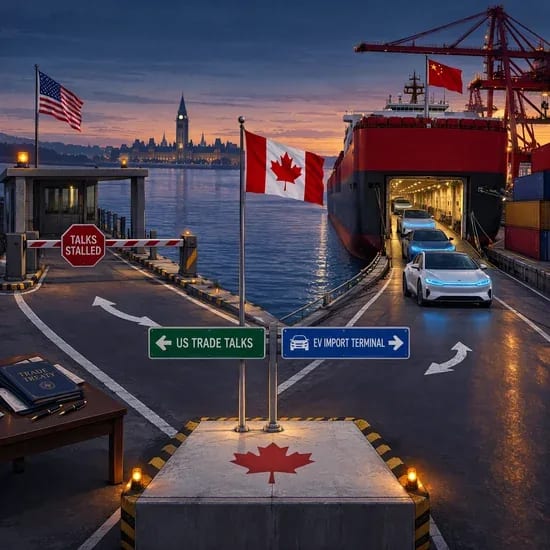
Canadian Prime Minister Mark Carney says Canada could pursue partnerships with Chinese automakers if trade talks with Washington fail to protect North America’s integrated auto industry.
Carney spoke to reporters in Cambodia on Monday, days before he is due to meet Chinese leader Xi Jinping in Shenzhen. Car manufacturing is expected to be on the agenda. In January, the two leaders agreed to let tens of thousands of Chinese electric vehicles into Canada at reduced tariff rates.
“We have the best auto workers in the world, and we want them fully deployed and fully capable in an integrated North American market. That market has become less integrated because of US trade actions,” Carney said.
The US remains the priority
In Manila on Saturday, Carney said any trade deal with Washington must keep Canada’s auto industry viable. On Monday he said the US talks remain his priority. However, their outcome may decide whether Canada explores alternatives with European, Chinese or Japanese automakers.
Asked whether possible Chinese investment gave Canada leverage in the US talks, Carney replied: “It’s not leverage. But it’s action, reaction.”
“If our auto workers and production capacity are not fully used in a North American context, that creates other opportunities. Canada will move on both tracks,” he said.
The condition: real manufacturing, not just assembly
Carney said any Chinese investment would have to bring real manufacturing to Canada, not just the assembly of imported parts. That would require proper labor standards, production facilities and domestic supply chains that grow over time. Those supply chains would include Canadian critical minerals used in electric vehicles.
“It’s not just about kits. There has to be a manufacturing element here,” the prime minister said.
The January deal and its critics
Under the deal signed in January, Canada cut its 100% tariff on Chinese EVs to 6.1%. The deal initially allows 49,000 vehicles a year, and the quota is set to grow over time. In return, China agreed to lower tariffs on several Canadian farm products, including canola. Carney said at the time that he expected the deal to draw Chinese investment into Canada’s auto sector and create jobs.
The deal drew criticism from Doug Ford, premier of Ontario, the heart of Canada’s auto industry. Ford warned that letting Chinese EVs into the market could threaten Canadian jobs and put access to the US market at risk.
An industry under tariff pressure
The Detroit Three (Ford, General Motors and Stellantis) run plants in Canada, the US and Mexico. Parts sometimes cross the border several times before a vehicle is finished. President Donald Trump has repeatedly urged automakers to move production from Canada to the US.
Trump’s tariffs have hit Canada’s auto industry hard because it depends so heavily on cross-border production. The Canadian government recently threatened to sue Stellantis. The company moved production of the Jeep Compass from Brampton, Ontario, to Illinois and agreed to sell an idle Canadian assembly plant.
On Saturday, Carney said he had held detailed talks with Trump and senior US officials. He said the two sides had made progress toward a possible trade deal, though differences remain.