XPeng’s flying cars could appear on Chinese roads by summer 2027
Company executive says the Aridge aircraft is “no longer science fiction” but a real commercial product
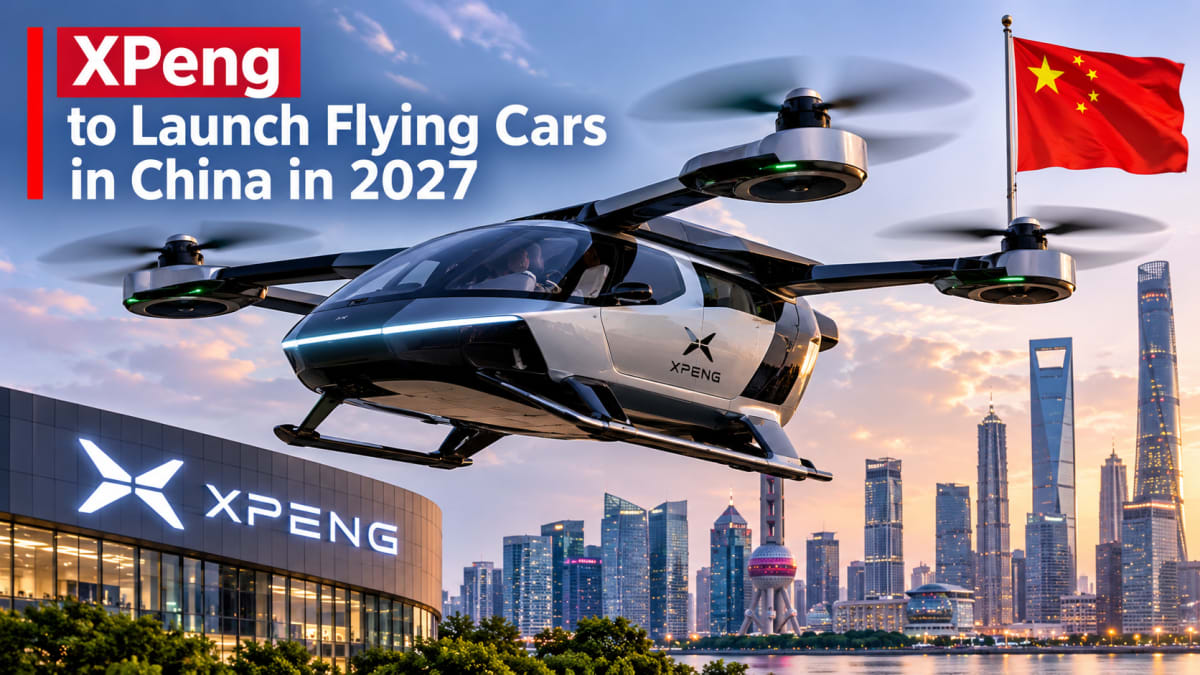
Company executive says the Aridge aircraft is “no longer science fiction” but a real commercial product
Michael Du, vice president and chief financial officer of China’s XPeng, told Euronews Next that people in China could begin traveling in so-called “flying cars” from the summer of 2027.
“This is no longer science fiction or a one-off demonstration aircraft. It is truly a commercial model,” Du said at the Web Summit technology event in Lisbon.
Limited deliveries first, then wider use
The two-seat, self-piloted XPeng Aridge low-altitude aircraft is close to mass commercial use. Limited deliveries to partners in China are expected within several months, followed by wider rollout. The vehicle has already been approved for limited use by Chinese civil aviation authorities.
The electric aircraft is priced at $300,000 (€270,000), and its cabin is about the size of a small car.
More than 7,000 pre-orders
According to Du, the company has received more than 7,000 pre-orders worldwide: “most of them in China, but there are also orders from the Middle East.” Customers include people interested in private flights and air tourism, as well as emergency-service and public-sector operators.
Tests in extreme conditions
The aircraft has completed technical flight tests at sea level and high altitude, and in cold, hot, windy and rainy conditions. “We tested it in various extreme conditions, so it is safe,” Du said.
The company spent ten years developing the technology at its mass-production plant in Guangzhou. XPeng has received type-test approval from the Civil Aviation Administration of China, and its test pilots have completed all test missions. The company is now in the final stage of type certification.
“Electrification will change aviation too”
Du believes electric aircraft will transform transport the way electrification transformed cars. He cited better power distribution, more redundant systems and quieter operation as advantages.
Speaking about the long-term impact on mobility, he recalled a Chinese saying: “If you want to develop the economy, first build roads. When you have better roads, accessibility increases for everyone.”
In his view, air transport offers “a different format for improving the efficiency of the transport system” and will “completely change how people travel, in terms of efficiency and economics over time.” The key advantage is that aircraft do not require continuous infrastructure: “You don’t need to build infrastructure centimeter by centimeter from takeoff to arrival. That’s how cars work. That’s how high-speed rail lines work.”
Du added that the vehicle could also be useful for island nations and sparsely populated regions.
When will it come to Europe?
After China, XPeng plans to work with foreign regulators and partners. The Middle East and Southeast Asia appear to be the most obvious early markets.
Du said Europe is “definitely a very attractive market” and that he hopes Web Summit will help introduce the product to European consumers, regulators and partners. However, obstacles must be overcome before entering the market, including delivering an affordable product and creating the necessary infrastructure and landing sites.
US-China tensions
Responding to a question about US-China tensions, Du said the company prefers more open markets and would be happy to enter the US market if regulatory conditions allow. He noted that China, the US and Europe together account for only half of the global aircraft market, so losing temporary access to one of them still leaves significant room for growth.
Du compared the situation to Chinese electric cars, which are now widely accepted in Europe: “Start small, start outside the city, start with cargo, start with passengers, gradually move to larger vehicles and expand toward cities. I think this could be one of the paths to more positive development of the industry.”